MASONIC EDUCATION · HISTORY & ESOTERIC TRADITIONS
Beyond the Craft: Side Degrees, Irregular Orders, and the Search for Further Light
When regular Masons founded independent initiatic societies, where did the Craft end—and where did a new tradition begin?
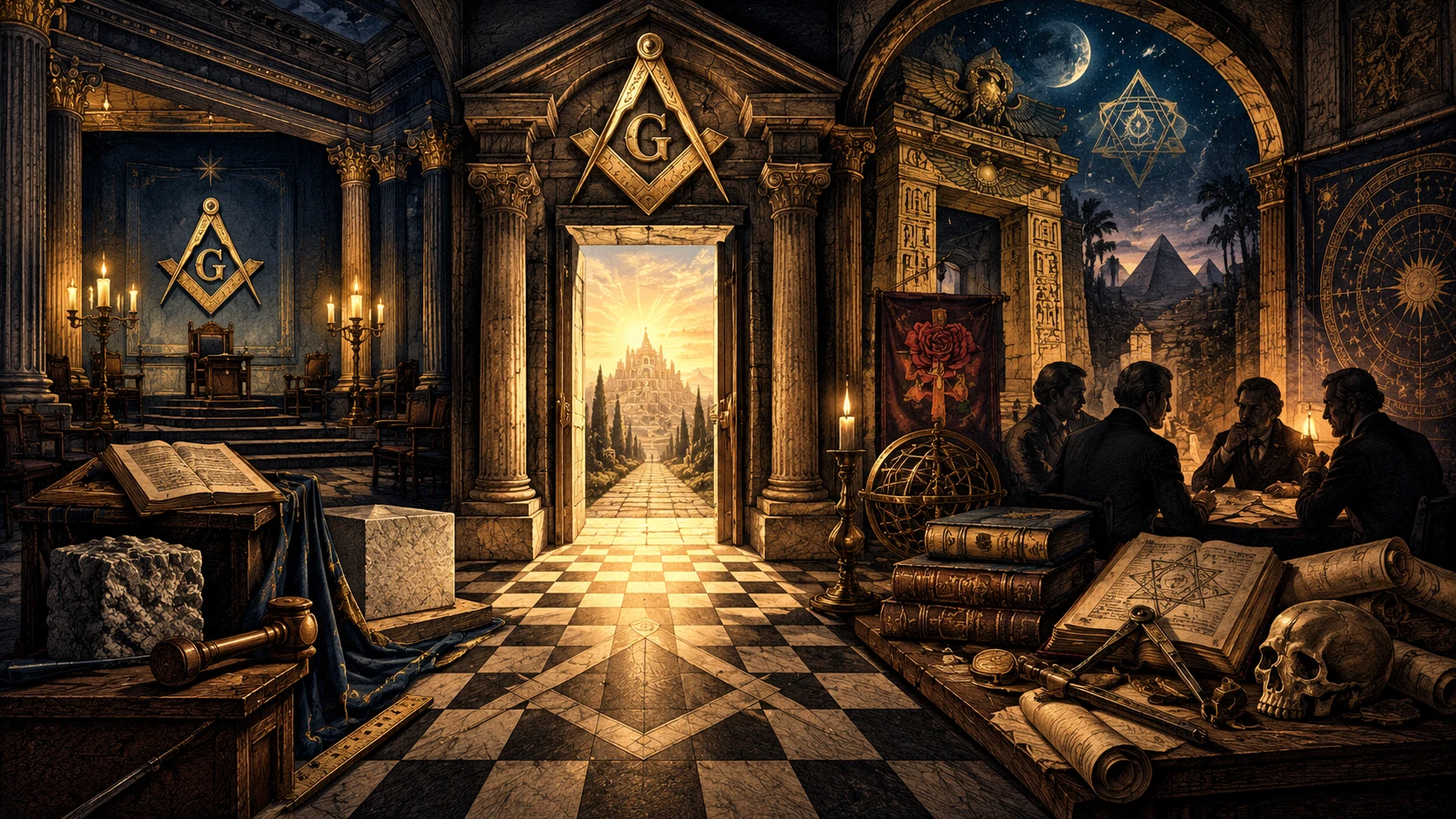
Imagine a group of Master Masons meeting after lodge. They are in good standing, devoted to the Craft, and fascinated by its neglected symbolism. One has discovered an old manuscript describing an unusual ceremony; another has translated a Rosicrucian tract; a third proposes that they organize a small society, confer a few degrees, and continue their studies together. Their new order never receives a warrant or recognition from a Grand Lodge. Are they suddenly irregular Masons?
The answer requires a distinction that has caused confusion for generations: the regularity of a Mason, the authority of a Masonic body, and the permissibility of a brother’s outside affiliations are related questions—but they are not the same question.
What Is a Side Degree?
In ordinary conversation, side degree can mean almost anything beyond the three Craft degrees: an additional ceremony, an invitational brotherhood, a higher-degree rite, or a self-described initiatic society. Historically, its meaning was narrower and often less institutional. Albert G. Mackey described honorary or side degrees as ceremonies outside the regular sequence of acknowledged degrees, frequently worked by small gatherings rather than under the authority of a Grand Lodge or Grand Chapter. Read Mackey’s entry on Side Degrees.
Today the landscape includes clearly established additional orders with their own governing bodies, private research societies, and independent esoteric fraternities founded or populated by Masons. These should not be lumped together. A Royal Arch chapter, a Rosicrucian college restricted to qualified Master Masons, and an occult order borrowing Masonic initiation techniques do not possess the same constitutional relationship to Craft Masonry.
Regular Members Do Not Automatically Make a Regular Body
Consider three separate tests:
- Personal standing: Is the individual a Master Mason in good standing in a lodge under a Grand Lodge recognized by the relevant jurisdiction?
- Institutional authority: Does the separate body have the governing authority it claims, and is it recognized, permitted, tolerated, or prohibited by the jurisdiction concerned?
- Actual conduct: Does it claim to confer Craft Masonry, imitate a Grand Lodge, use restricted forms or obligations, or otherwise violate the brother’s governing Masonic rules?
It is possible for the first answer to be yes while the second remains no. The third question may then determine whether membership is permissible. Importantly, lack of formal recognition does not itself prove that a study society is clandestine Masonry; conversely, calling an organization a harmless side order does not exempt it from Grand Lodge regulations.
This is not merely a historical technicality. The United Grand Lodge of England’s explanation of recognition concerns relations among sovereign Grand Lodges; it should not be mistaken for a blanket judgment on every independent study society or side degree.
What the United Grand Lodge of England Actually Says
The distinction can be seen in UGLE’s Book of Constitutions, under “Aims and Relationships of the Craft,” paragraph 9 (p. xi in the September 2025 edition):
“The Grand Lodge of England is a Sovereign and independent Body practising Freemasonry only within the three Degrees”
The paragraph continues by limiting its authority to what the Constitution defines as pure Antient Masonry and declining to acknowledge any superior Masonic authority. It is a statement about Craft jurisdiction and sovereignty—not an automatic declaration that every independent initiatic society is forbidden.
That distinction matters for side degrees. An organization composed entirely of regular Master Masons does not, simply by virtue of their membership, acquire recognition or authority from their Grand Lodges. Equally, absence of recognition does not alone establish that participation is prohibited. Whether a brother may join depends on what the separate organization claims and does, together with the rules of his own Grand Lodge.
Source: United Grand Lodge of England, Book of Constitutions, “Aims and Relationships of the Craft,” paragraph 9. See the official Book of Constitutions page for the latest edition.
The Nineteenth-Century Laboratory of Degrees
The nineteenth century was extraordinarily fertile ground for what might be called ritual experimentation. Scholars, antiquarians, spiritual seekers, and ambitious organizers collected old ceremonies, revised forgotten grades, and assembled elaborate systems of initiation. Some movements eventually developed stable, accepted relationships within the wider Masonic family. Others remained small, disputed, or deliberately independent.
The appeal was understandable. Craft Masonry supplied a powerful symbolic grammar: building, light, obligation, moral discipline, and the passage from ignorance toward knowledge. Yet some brethren desired additional instruction drawn from chivalric romance, biblical history, Rosicrucianism, Kabbalah, Hermetic philosophy, or the religious imagination of ancient Egypt. Their response was not always to change their Craft lodges. Often, it was to build another organization beside them.
John Yarker: Collector, Reformer, and Provocateur
Few men illustrate the unsettled frontier better than John Yarker (1833–1913). Initiated into English Freemasonry in 1854, Yarker pursued an astonishing range of additional rites and became absorbed by the history of ceremonies that had fallen out of ordinary use. He argued, in effect, that no single modern governing body could necessarily claim exclusive ownership of ritual material inherited, borrowed, or compiled from earlier sources.
That attitude brought him into serious conflict with established authorities. Yarker developed the Ancient and Primitive Rite in England through a charter linked to Harry J. Seymour, while controversy surrounding the Memphis and Misraïm systems followed him for years. His opponents could see a rival and questionable authority; supporters saw a man trying to preserve neglected initiatic traditions.
His story demonstrates why disputes over regularity were not simply arguments over the sincerity or character of a candidate. They were disputes about jurisdiction, provenance, ritual control, and the right to confer degrees. Historian Richard Kaczynski’s biographical study of Yarker offers a compelling account of these battles, including his disputes with the established Ancient and Accepted Rite.
Westcott: From Masonic Rosicrucianism to the Golden Dawn
William Wynn Westcott (1848–1925) presents a different model. He was deeply involved in recognized Craft Masonry and Masonic research, while also pursuing Rosicrucianism and ceremonial esotericism. The Societas Rosicruciana in Anglia (SRIA) furnished an important meeting place for Masons interested in Christian mystical philosophy. It was a separate society, not an alternative Grand Lodge conferring the Craft degrees.
In 1888 Westcott, together with S. L. MacGregor Mathers and William Robert Woodman, helped launch the Hermetic Order of the Golden Dawn. The Golden Dawn used a graded initiatic structure indebted in part to the esoteric culture in which these Masons moved, but it was not an ordinary Masonic side degree or a recognized appendant body. Its membership and purposes differed significantly from Craft Masonry.
Westcott makes the distinction vivid: a man could be a committed Mason and at the same time help establish an order whose legitimacy derived from an entirely different claimed source. Such an institution might borrow from Masonic organizational forms without being constitutionally Masonic. For more, see Llewellyn’s history of the Golden Dawn and this extended biography of Westcott.
Arthur Edward Waite: Initiation Beyond the Lodge
Arthur Edward Waite (1857–1942) combined remarkable knowledge of Masonic and occult literature with a conviction that initiation should point beyond ceremony toward inward spiritual development. A Freemason from 1901 and a member of multiple additional bodies, he became dissatisfied with aspects of the Golden Dawn and developed his Independent and Rectified Rite.
In 1915 he established the Fellowship of the Rosy Cross, an avowedly Christian mystical society whose initiatory system drew upon the language and structure of earlier esoteric orders. Men and women participated in its original form; it did not begin as a body requiring Masonic membership. That detail is decisive: Waite’s fellowship cannot honestly be described as an orthodox Masonic additional degree simply because its founder and many participants were Masons.
Waite also reminds us that the world of side degrees was not always about accumulating titles or claiming ever-higher rank. For some, it was an effort to create a school of inner interpretation. The Quatuor Coronati research paper on Waite’s Masonic career and the Fellowship’s own historical account are excellent complementary readings.
From Collecting Degrees to Preserving Ritual: The Allied Masonic Degrees
Not every detached degree disappeared, nor did every effort to preserve one mean setting up a rival grand body. The Allied Masonic Degrees (AMD) demonstrate how once-scattered ceremonies could find an organized home. The American Grand Council describes its degrees as detached workings, some formerly conferred under Craft warrants or transmitted as side degrees when Masonic governance was less standardized. Rather than claiming to replace Craft Masonry, its councils maintain a distinct collection of degrees and encourage research into Masonic history and philosophy.
In the United States, AMD is an invitational appendant organization: members must belong to a symbolic lodge and to the Royal Arch. Its historical development traces through an American body founded in 1892, a Grand Council organized in 1932, and their union in 1933. Working degrees such as the Royal Ark Mariner, Knight of Constantinople, and Grand Tilers of Solomon allows selected material to remain part of a living ritual practice rather than survive only in books. The details and degrees differ across countries, however, and their legitimacy should not be generalized across every jurisdiction.
Read the Grand Council’s history of the Allied Masonic Degrees; its degree descriptions offer an excellent starting point for studying these once-detached workings.
The Grand College of Rites: A Library for Rituals That Might Otherwise Vanish
The Grand College of Rites of the United States of America follows a related but importantly different philosophy. Established on May 12, 1932, it describes itself as a regular Masonic body devoted to the history and rituals of defunct and inactive Masonic orders. Its constitution calls for studying rites beyond the stewardship of existing recognized bodies and collecting rituals not normally accessible to students. It also expressly avoids encroaching on the active ritual systems of established Masonic organizations.
This is not simply an organization for conferring every extinct degree it finds. Its signature achievement is Collectanea, its series of privately issued transactions that publish ritual texts preserved in its archives for its Fellows. The difference is subtle but consequential: the archive can preserve a rite’s words and history without urging an uncritical return to its old claims, authority, or practices.
The organization’s beginnings are especially revealing. According to the College’s own history, the brethren involved first revived the dormant Egyptian Rite of Memphis long enough to secure its ritual and archival authority; in 1932 its Sovereign Sanctuary transferred that authority to the newly formed Grand College. This was a carefully organized act of ritual custody, not evidence that the College intended to compete with recognized Craft Grand Lodges. Read the College’s documented founding history, its constitution, and its description of Collectanea.
The Brethren Who Saved the Papers
J. Raymond Shute II was among the driving organizers of this preservation effort. In 1931 he pursued surviving connections to the Egyptian Rite of Memphis and helped plan a body that would print and safeguard dormant ritual texts. His later reminiscence, The Innovators, describes a remarkably interconnected American world of research lodges, small Masonic bodies, and historical investigation. Shute’s legacy reframes the question of a side degree: what becomes of its lessons after the last council closes?
Harold Van Buren Voorhis was Shute’s fellow researcher and an organizer and early Grand Registrar of the Grand College of Rites. Shute later credited Voorhis with substantial work in revitalizing the Societas Rosicruciana in Civitatibus Foederatis. Voorhis represents the patient work of the collector and institution-builder, gathering dispersed evidence and providing it with a durable home.
Henry V. A. Parsell provided an unlikely bridge to an earlier generation. Identified in the College’s historical account as a surviving member of the dormant Egyptian Rite of Memphis, he participated in its 1931 reorganization and the 1932 formation of the Grand College. His role illustrates a basic problem in ritual history: a fragile continuity may rest on the recollections, papers, and authority of a handful of aging brethren.
These men deserve attention beside the better-known European esotericists. Unlike Yarker, Westcott, or Waite, their central achievement here was not the creation of a wholly new mystical system. It was building an institutional mechanism through which the record of old systems could outlive them. See the College’s founding minutes and historical summary and Shute’s The Innovators.
Two Models of Preservation, One Masonic Responsibility
Allied Masonic Degrees and the Grand College of Rites are not interchangeable. AMD preserves and works a defined collection of additional degrees under its own recognized organizational arrangements; the Grand College researches, safeguards, and publishes historical rites, especially those no longer under active recognized stewardship. They represent complementary answers to the fate of ritual fragments: some ceremonies remain alive through carefully governed practice, while others are preserved as documentary evidence for future study.
For the Mason searching for further light, their example offers an alternative to two extremes: treating every old degree as unquestionably authentic, or dismissing any forgotten ceremony as worthless because it lost its original body. Historical preservation demands curiosity, but it also demands clear distinctions between evidence, interpretation, and legitimate authority.
Why the Distinction Still Matters
The lesson is not that every historical side degree deserves revival, or that all disputed bodies were unjustly condemned. Some may have preserved valuable symbolism; others may have traded in inflated pedigrees, uncertain warrants, and grandiose titles. The lesson is that historical importance, spiritual value, and Masonic recognition are different kinds of judgment.
A Mason can recognize imaginative power in an old ritual without affirming its claim to ancient origin. He can appreciate Westcott’s scholarship without confusing the Golden Dawn with the Craft. He can read Waite without making his mystical fellowship an appendant Masonic body. He can study Yarker’s encyclopedic legacy without endorsing every charter he issued.
Perhaps the most useful question is not, “How many degrees did these men collect?” but rather, “What did these additional ceremonies seek to teach—and what is lost when their texts and history disappear?” Their answers may tell us as much about the intellectual longings of their age as about the rituals they founded.
A Question for the Lodge
If a group of regular Master Masons establishes an independent initiatic society that does not pretend to be a Craft lodge, what should determine its place in Masonic life: its membership, its teachings, its ritual origins, its institutional authority, or the rules of the brethren’s Grand Lodge?
The history of side degrees offers no single answer for every jurisdiction. It does offer an excellent subject for thoughtful discussion—and a reminder that the search for further light must be joined to discernment.
Further Reading & Historical Sources
- Albert G. Mackey, “Side Degrees” — historical terminology.
- United Grand Lodge of England, Recognition of Foreign Grand Lodges — current recognition framework.
- UGLE, Book of Constitutions — “Aims and Relationships of the Craft,” paragraph 9, on the sovereignty and constitutional scope of Craft Masonry (official page with current edition).
- Richard Kaczynski, “John Yarker” — contested rites and authority.
- History of the Golden Dawn — Westcott, Mathers, and Woodman.
- “The Masonic Career of A. E. Waite” — research perspective on Waite.
- Fellowship of the Rosy Cross, History — institutional perspective.
- Allied Masonic Degrees, History — American organization and survival of detached degrees.
- Allied Masonic Degrees, Degrees — description of individual workings.
- Grand College of Rites, Constitution — mission and parameters of ritual preservation.
- Grand College of Rites, Historical Summary — Shute, Voorhis, Parsell, and the 1932 founding.
- J. Raymond Shute II, “The Innovators” — first-person institutional recollections.
Editorial note: This is a historical and educational essay, not a ruling on the legitimacy or permissibility of any contemporary body. Grand Lodge requirements vary by jurisdiction. Original illustrations are artistic reconstructions rather than historical photographs or authenticated ritual documents.