What might the mystical teachings of Kabbalah reveal to a Freemason about the Divine Name, the structure of creation, and the labor of improving oneself? The two traditions arose in different settings and serve different purposes. Yet a careful comparison opens a rewarding conversation about sacred language, moral responsibility, and the search for wisdom.
Two Traditions, One Fascinating Conversation
Kabbalah is a stream of Jewish mysticism, not a separate religion. Its major medieval expressions developed within Jewish religious life, especially in the 12th and 13th centuries. Works such as the Sefer Yetzirah (Book of Creation), an earlier mystical text, and the later Zohar (Book of Splendor) explore creation, divine attributes, sacred letters, and the relationship between God and humanity.
Freemasonry, by contrast, is an initiatic fraternity that teaches ethical conduct through the language of architecture. Its working tools, the Temple of Solomon, and the journey from rough to perfect ashlar invite a Mason to become more thoughtful, upright, and useful to others.
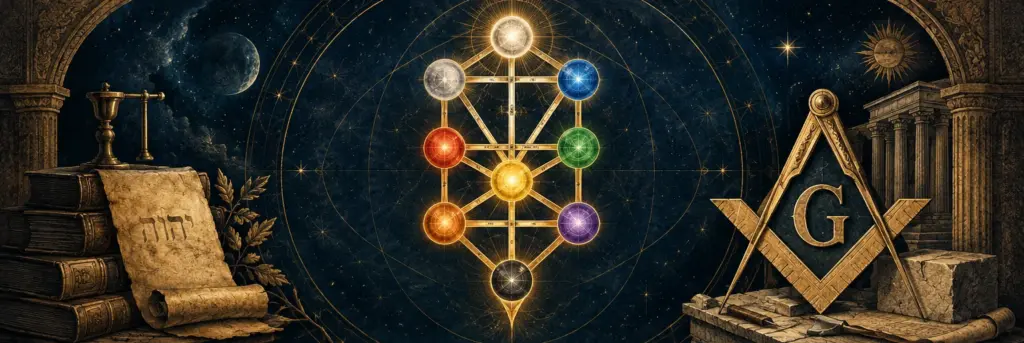
One of Kabbalah’s best-known teachings is the system of the ten sefirot: divine attributes or emanations often represented in the configuration called the Tree of Life. They are not ten separate gods, but a symbolic way to contemplate aspects of divine manifestation and relation.
There have been historical points of contact between Masons and later Western esoteric writers who studied Kabbalistic ideas. Nevertheless, a similarity of symbols is not, by itself, evidence that one ritual or teaching descended from the other. The comparison is most illuminating when we distinguish the established teachings of each tradition from imaginative, later interpretations.
The Divine Name: A Mystery Beyond Words
In Jewish tradition, the four Hebrew letters יהוה—commonly transliterated YHWH and called the Tetragrammaton—hold singular importance. The Name is treated with profound reverence; it is not ordinarily pronounced as written. In Kabbalistic interpretation, its letters become a way of meditating upon creation and the relation of the finite world to the Infinite.
Particular attention is sometimes given to yod (י), the small first letter of the Name. Its compact shape offers a striking symbol of beginnings: a point from which thought, meaning, and creative possibility unfold. In this reading, the least conspicuous mark can suggest the greatest mystery.
For a Mason, this offers an interpretive parallel rather than a ritual equivalence. The Craft uses names, words, and architectural images to direct attention toward truths that cannot be fully captured by ordinary speech. The shared question is not whether one possesses a secret syllable, but how reverence for what transcends us ought to change the way we live.
The Letter G: Geometry, God, and the Creative Principle
One of the most recognizable images in American Freemasonry is the letter G within the square and compasses. Its familiar explanations include Geometry, the science so closely associated with the builder’s art, and God, understood within Masonry’s language of the Great Architect of the Universe. The exact emblem and the emphasis placed on its meanings can vary among Masonic jurisdictions.
Geometry is more than a practical skill in the Masonic imagination. It suggests proportion, harmony, intelligible order, and the discipline required to turn an idea into a structure that can stand. As the operative builder employs the rule and compasses to shape material, the speculative Mason is encouraged to bring order to his own conduct.
Some esoteric Masonic commentators have also connected the G with the generative principle, or compared it to the Kabbalistic symbolism of yod. This is a thoughtful symbolic analogy, not a universally taught explanation of the letter G and not proof that the Masonic emblem arose from the Tetragrammaton.
The question worth carrying into the lodge is practical: If creation is marked by order and purpose, how deliberately do we shape our own actions?
The Four Worlds: From Emanation to Action
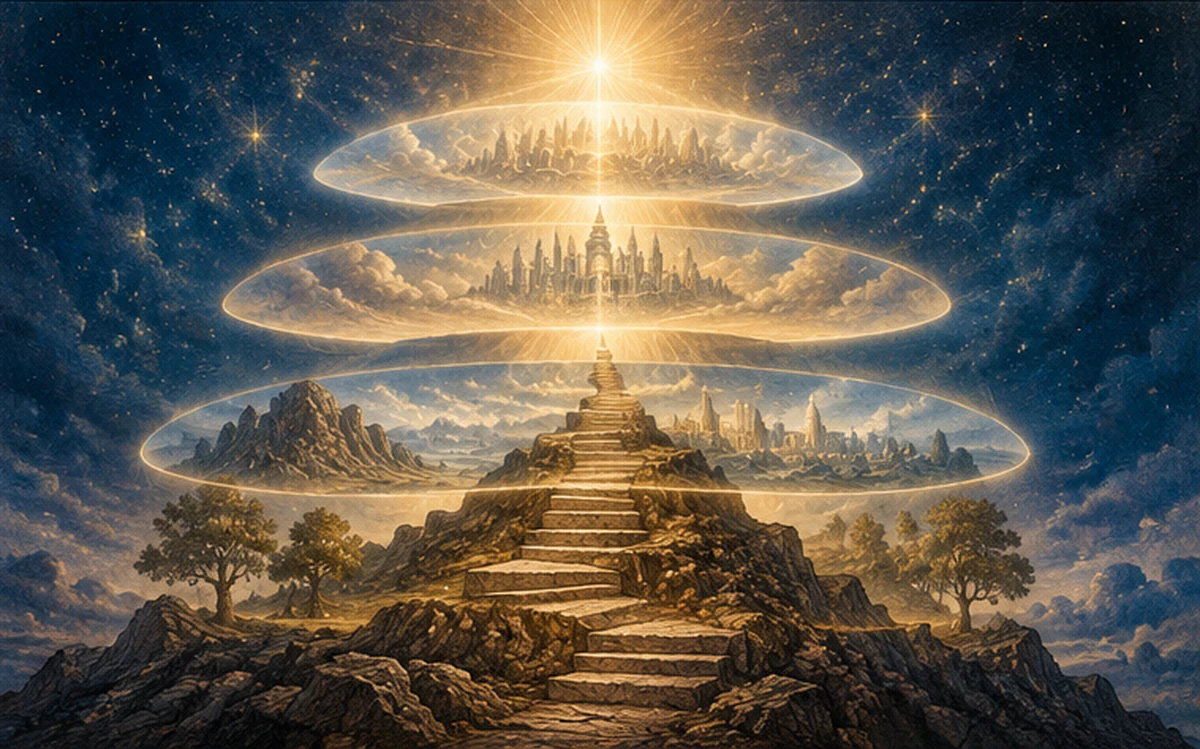
One of the most compelling frameworks in Kabbalistic thought is the teaching of the Four Worlds. These are not four planets or physical locations. They describe different orders of divine manifestation, often expressed as a movement from hidden spiritual reality toward the world of concrete action.
- Atzilut — Emanation. The realm of closest divine unity, in which the creative source is contemplated before the emergence of independent created existence.
- Beriah — Creation. The emergence of an intelligible conception or archetypal pattern: creation considered at the level of its unfolding possibility.
- Yetzirah — Formation. The ordering and shaping of what has been conceived, associated in many Kabbalistic discussions with the angelic world.
- Assiah — Action. The realm of enactment and material reality, where possibilities take visible form and our decisions have consequences.
The comparison with building is irresistible: conception, design, formation, and construction. An architect’s vision must pass through successive stages before it becomes a temple. So, too, may a Mason’s noble intentions remain incomplete until they are made visible in conduct.
It would go too far to declare that the three Craft degrees are three or four Kabbalistic worlds; there is no established one-to-one correspondence. Yet the analogy between progressive understanding and deliberate inner construction can be a fruitful subject for reflection.
Five Dimensions of the Soul and the Rough Ashlar
Kabbalistic writings also speak of five dimensions or levels of the soul. The terminology is subtle, and interpretations vary among Jewish schools, but a useful introductory outline is:
- Nefesh: life and vitality, associated with embodied existence and action.
- Ruach: spirit, character, and emotional or moral life.
- Neshamah: a higher spiritual-intellectual dimension, linked to understanding.
- Chayah: a transcendent dimension of life and awareness.
- Yechidah: the soul’s deepest singularity and bond with the Divine.
These are not simply five rungs on a ladder of personal achievement, nor a set of Masonic degrees in disguise. They express a rich religious understanding of the human being. The Masonic comparison is more modest: a person possesses depths of responsibility and possibility that are not exhausted by the habits of everyday life.
Here the rough and perfect ashlars provide perhaps the clearest bridge. The rough ashlar represents work yet to be done; the perfect ashlar, the ideal of a character made fit for the builder’s use. The point is not that a man becomes flawless. Rather, he learns to recognize what must be corrected, strengthened, or brought into proper alignment.
The most meaningful comparison is not between two diagrams, but between two calls to transformation: what we learn inwardly must become what we practice outwardly.
Angels, Tarot, and the Later Hermetic Qabalah
Not every esoteric idea commonly associated with Kabbalah belongs to the same historical tradition. Jewish Kabbalah includes complex teachings about angels, divine attributes, and the worlds of creation. Its accounts of spiritual hierarchies are not all identical. Freemasonry does not, as a general matter, teach a corresponding system of angelic ranks.
Connections involving the Tarot, the twenty-two Hebrew letters, and the Holy Guardian Angel belong primarily to later Western esoteric developments, often described as Hermetic Qabalah. In the nineteenth century, figures and organizations such as Éliphas Lévi and the Hermetic Order of the Golden Dawn brought together Jewish mystical imagery, Renaissance occult traditions, Tarot symbolism, and initiatic methods. The Holy Guardian Angel became especially prominent in ceremonial-magical traditions.
These later syntheses can be interesting to students of esoteric Freemasonry, and individual Masonic writers—including Albert Pike—engaged extensively with comparative symbolism. But neither Tarot correspondences nor the Holy Guardian Angel should be presented as standard instruction in the three degrees of Craft Masonry, or as original teachings of Jewish Kabbalah.
Respecting those distinctions does not diminish the symbolic conversation. It makes it more intellectually honest—and therefore more valuable.
The Great Work of a Mason: Making Wisdom Visible
What, then, remains after we set aside claims of identical origins and hidden equivalences? Something considerable.
Kabbalistic contemplation places deep weight on the relationship between the sacred and the ordinary world. Masonic instruction insists that principles must be translated into the conduct of a life: truthfulness in speech, justice in decisions, care for a Brother in difficulty, and service beyond the lodge room.
One can approach the Divine Name with reverence, consider the mystery suggested by a single letter, or meditate upon the passage from thought to action. Yet the crucial test is whether these reflections make us better builders of our own character and more faithful stewards of our obligations.
The temple is not completed by contemplating the plan alone. It is completed, stone by stone, through labor.
Perhaps that is the strongest connection between Kabbalah and Freemasonry—not a claim that they are the same path, but the conviction that human beings are invited to look beyond appearances, seek wisdom with humility, and give that wisdom shape in the world.
A Question for the Brethren
When we speak of seeking more light, are we seeking only a greater store of knowledge—or a deeper transformation in how we think, judge, and act?
Further Reading
- My Jewish Learning — Kabbalah: Origins of a Spiritual Adventure
- My Jewish Learning — Sefer Yetzirah: The Book of Creation
- Chabad.org — The Four Worlds
- Chabad.org — Levels of Soul Consciousness
- Grand Lodge of Ohio — Behind the Masonic Symbols: The Square and Compasses
- Yale University Press — The Hermetic Order of the Golden Dawn and the Origins of Wicca